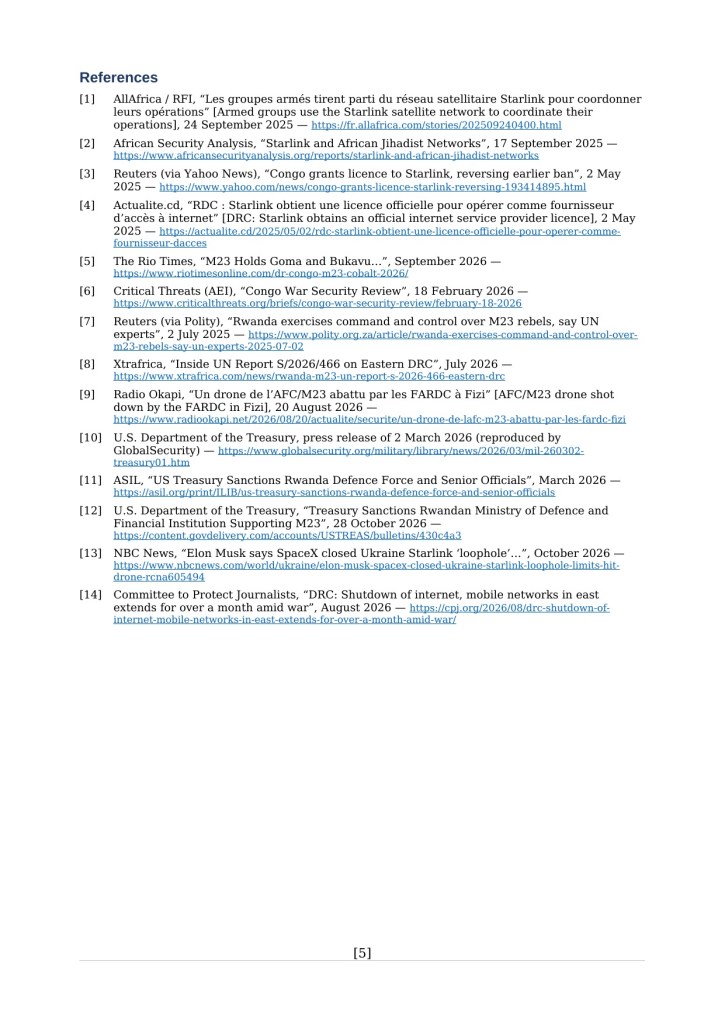
For a targeted restriction of the Starlink service in areas where the M23/FRN, Rwandan forces and the ADF operate
To:
- SpaceX / Starlink (and Starlink DRC S.A.)
- Congolese Postal and Telecommunications Regulatory Authority (ARPTC)
- Government of the Democratic Republic of the Congo
- Competent United States authorities: Department of State; Department of the Treasury – Office of Foreign Assets Control (OFAC)
- Mr. Elon Musk, CEO of SpaceX, @elonmusk
Subject: Request for targeted technical measures (terminal deactivation and geo-restriction) against the use of the Starlink service by the M23/FRN, the ADF and the Rwanda Defence Force (RDF), entities under US sanctions, in North Kivu, South Kivu and Ituri
Dear Sir or Madam,
We wish to draw your attention to the risk, documented for some actors and serious for others, that the Starlink service is being diverted for the benefit of armed groups active in the eastern Democratic Republic of the Congo: the M23 and its political coalition, formerly the Alliance Fleuve Congo, also known as FRN; the Allied Democratic Forces (ADF), affiliated with the Islamic State under the name ISCAP; and the Rwanda Defence Force (RDF), which operates alongside the M23 and is subject to US sanctions.
1. Use already documented in the case of the ADF
The ADF’s use of Starlink is now supported by consistent sources:
- As early as December 2024, the final report of the United Nations Group of Experts on the DRC pointed to the ADF’s probable use of Starlink to connect their main camp at Madina with their external networks, including those of the Islamic State in East Africa [1].
- On 17 September 2025, the Swedish think tank African Security Analysis (ASA) reported that the network of ADF leader Musa Baluku had obtained Starlink kits in Butembo (North Kivu), and that the same facilitation network had bought commercial drones there, reflecting a parallel investment in surveillance and propaganda [1][2].
- According to ASA, this connectivity supports command, communications, and faster, higher-quality propaganda disseminated in several languages [1].
2. A serious risk regarding the M23/FRN and Rwandan forces
To our knowledge, the use of Starlink terminals by the M23 or the RDF constitutes a concrete risk that warrants immediate verification by SpaceX:
- The threat was identified by the Congolese authorities themselves. In March 2024, the ARPTC banned Starlink after military officials warned that the service could be exploited by rebel groups, including the Rwanda-backed M23 [3]. The ARPTC subsequently granted a licence to Starlink DRC S.A. on 2 May 2025 [4].
- The M23/FRN holds vast territories on a lasting basis. Goma and Bukavu, captured in early 2025, remain under its control, and in September 2026 the coalition controlled much of North and South Kivu [5]. Terrestrial networks in these areas are regularly cut: in early 2026, some residents of North Kivu could only reach the internet through rare and expensive Starlink terminals [6].
- Rwandan forces are waging a technology-driven war. In July 2025, the UN Group of Experts concluded that Rwanda exercised command and control over the M23 and had deployed high-tech systems capable of neutralising air assets [7]. Its report S/2026/466 estimates the RDF presence in eastern DRC at 14,000–18,000 troops and describes the use of GPS-guided mortars, kamikaze drones and jamming systems during the Uvira offensive [8]. Operations of this kind depend on high-bandwidth, low-latency connectivity.
- Drones attributed to the M23/RDF remain active. On 20 August 2026, the FARDC announced that they had shot down, at Ruyengo (Fizi territory, South Kivu), a kamikaze drone attributed to the RDF/M23 and their Twirwaneho/Red-Tabara allies [9]. Most recently, on 17 November 2026, the FARDC destroyed another Starlink centre used for drone guidance in North Kivu.
- Terminals can enter through neighbouring countries. Starlink is sold in Rwanda and in several other countries in the region; kits purchased or activated outside the DRC can be used in the occupied areas, beyond any oversight by the ARPTC.
It is precisely because SpaceX holds the activation, billing and location data for its terminals that it is best placed to establish the facts.
3. SpaceX’s obligations under US sanctions
On 2 March 2026, OFAC designated the Rwanda Defence Force and four senior military officials under Executive Order 13413 for their direct support to the M23 [10][11]. On 28 October 2026, OFAC extended these sanctions to the Rwandan Ministry of Defence, which oversees the RDF, and to the Zigama Credit and Savings Society, a financial institution serving the Rwandan security forces [12].
Consequently, any US person or company, including SpaceX, is prohibited from providing goods or services, directly or indirectly, to these blocked entities, regardless of the currency of payment. OFAC imposes civil penalties on a strict liability basis [11]. Providing Starlink connectivity to RDF (Rwandan army) units operating in the DRC, or to intermediaries acting on their behalf, would therefore expose SpaceX to a sanctions violation.
4. A precedent: SpaceX knows how to restrict its service
SpaceX has repeatedly demonstrated its ability to limit the use of Starlink when it considers its terms of service to have been breached. As recently as October 2026, Elon Musk stated that SpaceX had closed a “loophole” in Ukraine, asserting that using Starlink, a civilian commercial service, for offensive drone strikes has never been permitted [13]. We ask that this same principle be applied consistently in the DRC, where armed groups responsible for serious violations of international humanitarian law, as well as forces under US sanctions, are in a position to exploit the service.
5. Preserving civilian access
In the conflict zones of eastern DRC, Starlink is also a vital tool for local populations, health facilities, humanitarian organisations and the media, which are often left with no other means of access during internet shutdowns. In July 2026, in Fizi territory, soldiers confiscated the Starlink kits of several community radio stations during a prolonged network shutdown [14]. Any measure must therefore target armed actors, not penalise civilians.
6. Our requests
- An immediate audit by SpaceX of active terminals in North Kivu, South Kivu and Ituri, particularly in areas controlled by the M23/FRN and in the ADF’s areas of operation, including terminals registered in neighbouring countries and used in roaming mode.
- Targeted deactivation of any terminal whose use by the M23/FRN, the ADF, the RDF or their intermediaries is established or strongly suspected, together with the blocking of the associated accounts and payment methods.
- Targeted geo-restriction of clearly identified military positions and areas of operation, rather than a blanket shutdown that would deprive civilians of their last means of communication.
- A whitelisting mechanism established with the ARPTC, United Nations agencies and humanitarian organisations, to guarantee access for hospitals, humanitarian actors, independent media and civilian populations.
- Stronger sales controls (buyer identification, traceability of kits sold through authorised resellers in the region, monitoring of prolonged roaming).
- An OFAC compliance review covering customers, resellers and payment methods linked to the RDF, the Rwandan Ministry of Defence and the Zigama Credit and Savings Society, and the transmission of any relevant information to the US authorities.
- A public transparency report on the measures taken in the region.
Starlink is a dual-use technology. Its exploitation by armed groups that commit serious human rights violations, and by forces under US sanctions, endangers civilians and runs counter to both SpaceX’s public commitments and its legal obligations.
We call on SpaceX, the Congolese authorities and international partners to act swiftly and in a targeted manner so that this service does not serve as a tool of war for the M23/FRN, the ADF and the sanctioned Rwandan forces.
We remain available for any discussion to specify the areas concerned and the technical arrangements for implementation.
For Démocratie Chrétienne (DC),
Hon. Eugène Diomi Ndongala
democratiechrétienne.com
References
- AllAfrica / RFI, “Les groupes armés tirent parti du réseau satellitaire Starlink pour coordonner leurs opérations” [Armed groups use the Starlink satellite network to coordinate their operations], 24 September 2025 — https://fr.allafrica.com/stories/202509240400.html
- African Security Analysis, “Starlink and African Jihadist Networks”, 17 September 2025 — https://www.africansecurityanalysis.org/reports/starlink-and-african-jihadist-networks
- Reuters (via Yahoo News), “Congo grants licence to Starlink, reversing earlier ban”, 2 May 2025 — https://www.yahoo.com/news/congo-grants-licence-starlink-reversing-193414895.html
- Actualite.cd, “RDC : Starlink obtient une licence officielle pour opérer comme fournisseur d’accès à internet” [DRC: Starlink obtains an official internet service provider licence], 2 May 2025 — https://actualite.cd/2025/05/02/rdc-starlink-obtient-une-licence-officielle-pour-operer-comme-fournisseur-dacces
- The Rio Times, “M23 Holds Goma and Bukavu…”, September 2026 — https://www.riotimesonline.com/dr-congo-m23-cobalt-2026/
- Critical Threats (AEI), “Congo War Security Review”, 18 February 2026 — https://www.criticalthreats.org/briefs/congo-war-security-review/february-18-2026
- Reuters (via Polity), “Rwanda exercises command and control over M23 rebels, say UN experts”, 2 July 2025 — https://www.polity.org.za/article/rwanda-exercises-command-and-control-over-m23-rebels-say-un-experts-2025-07-02
- Xtrafrica, “Inside UN Report S/2026/466 on Eastern DRC”, July 2026 — https://www.xtrafrica.com/news/rwanda-m23-un-report-s-2026-466-eastern-drc
- Radio Okapi, “Un drone de l’AFC/M23 abattu par les FARDC à Fizi” [AFC/M23 drone shot down by the FARDC in Fizi], 20 August 2026 — https://www.radiookapi.net/2026/08/20/actualite/securite/un-drone-de-lafc-m23-abattu-par-les-fardc-fizi
- U.S. Department of the Treasury, press release of 2 March 2026 (reproduced by GlobalSecurity) — https://www.globalsecurity.org/military/library/news/2026/03/mil-260302-treasury01.htm
- ASIL, “US Treasury Sanctions Rwanda Defence Force and Senior Officials”, March 2026 — https://asil.org/print/ILIB/us-treasury-sanctions-rwanda-defence-force-and-senior-officials
- U.S. Department of the Treasury, “Treasury Sanctions Rwandan Ministry of Defence and Financial Institution Supporting M23”, 28 October 2026 — https://content.govdelivery.com/accounts/USTREAS/bulletins/430c4a3
- NBC News, “Elon Musk says SpaceX closed Ukraine Starlink ‘loophole’…”, October 2026 — https://www.nbcnews.com/world/ukraine/elon-musk-spacex-closed-ukraine-starlink-loophole-limits-hit-drone-rcna605494
- Committee to Protect Journalists, “DRC: Shutdown of internet, mobile networks in east extends for over a month amid war”, August 2026 — https://cpj.org/2026/08/drc-shutdown-of-internet-mobile-networks-in-east-extends-for-over-a-month-amid-war/